
Introduction: Best Lead Generation Tools for Industrial Companies in 2026
Lead Generation Tools for Industrial Businesses help manufacturers and B2B companies attract, track, and convert high-quality prospects. In 2026, these tools play a crucial role in digital marketing and industrial sales growth. If you want to explore the most effective <a href=”#”>Lead Generation Tools for Industrial Businesses</a>, understanding how they work can transform your marketing strategy. The year 2026 marks a decisive turning point for industrial marketing. Whether you manufacture precision components, supply heavy machinery, or provide engineering services, one challenge remains universal: finding and converting the right B2B buyers into paying customers. This is where the bestin 2026 become indispensable for driving consistent B2B growth.
Unlike consumer brands, industrial companies operate in long-cycle sales environm Lead Generation Tools for Industrial Businesses ents where a single contract can be worth hundreds of thousands of dollars. A misstep in lead qualification wastes months of effort. Conversely, a well-optimized lead generation strategy powered by the right tools can dramatically compress your sales cycle and fill your pipeline with high-intent prospects.
In this comprehensive guide — brought to you by KrishnaMarketingHub, a trusted digital marketing authority for industrial brands — we will explore the most effective lead generation tools available today, explain why they matter specifically in 2026, examine the key benefits they offer, highlight the latest trends shaping the space, and address the real challenges industrial marketers face. Let’s get started.
Why Lead Generation Matters for Industrial Companies in 2026
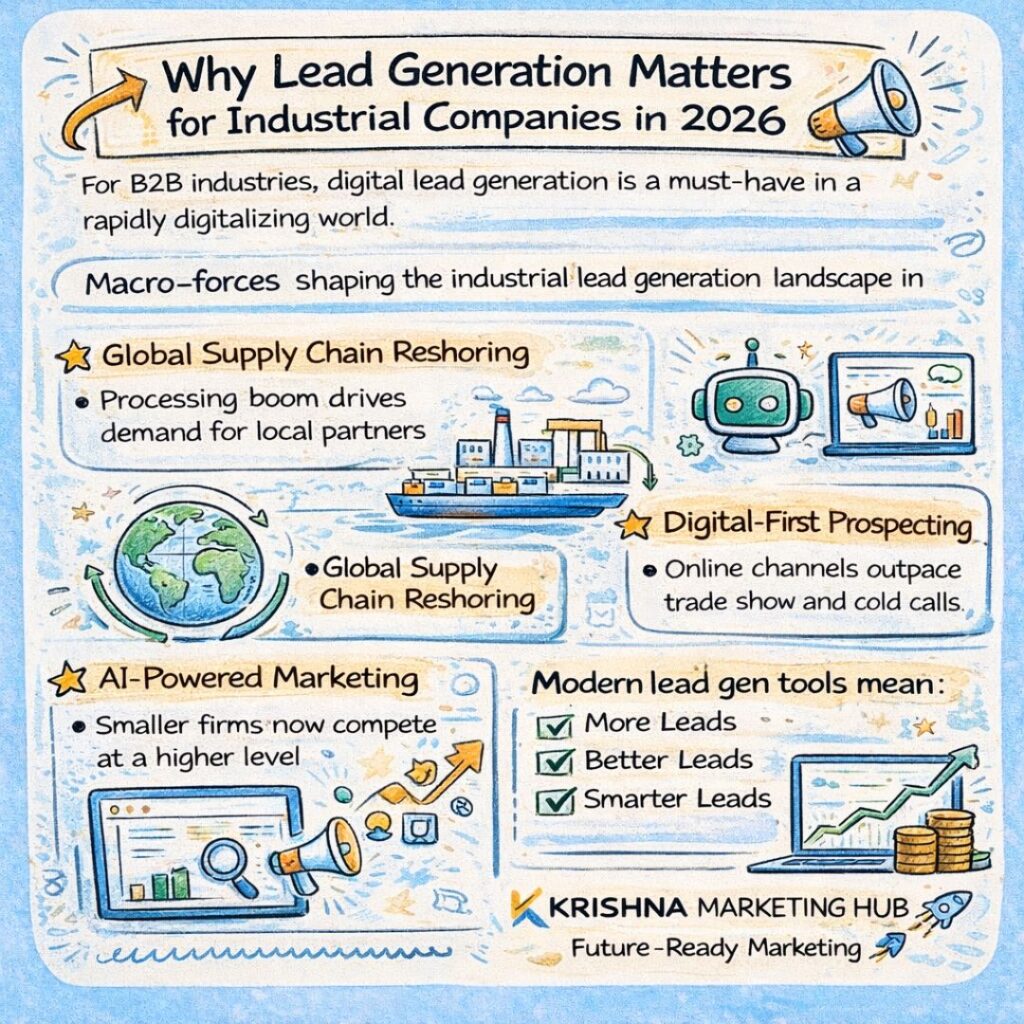
The industrial buying journey has changed fundamentally. According to a 2025 Gartner report, B2B buyers now complete more than 70% of their research online before ever speaking to a sales representative. This means that if your industrial company is not visible, credible, and engaging online, you are already losing leads to competitors who are.
Several macro-forces make 2026 a particularly critical year for industrial lead generation. First, global supply chain reshoring has accelerated demand for domestic industrial partners, creating a surge in procurement activity. Second, AI-powered platforms have lowered the barrier for smaller competitors to run sophisticated marketing campaigns, intensifying competition for the same buyers. Third, rising trade show costs and post-pandemic buyer habits mean that digital channels now carry far more weight than in-person prospecting once did.
For KrishnaMarketingHub clients across manufacturing, engineering, and industrial services, the companies that invest in modern lead generation tools in 2026 are consistently outpacing those relying on outdated methods like cold calling directories or static brochure websites. The data is clear: the right tools do not just generate more leads — they generate better leads.
Key Benefits of Using Lead Generation Tools for Industrial Companies
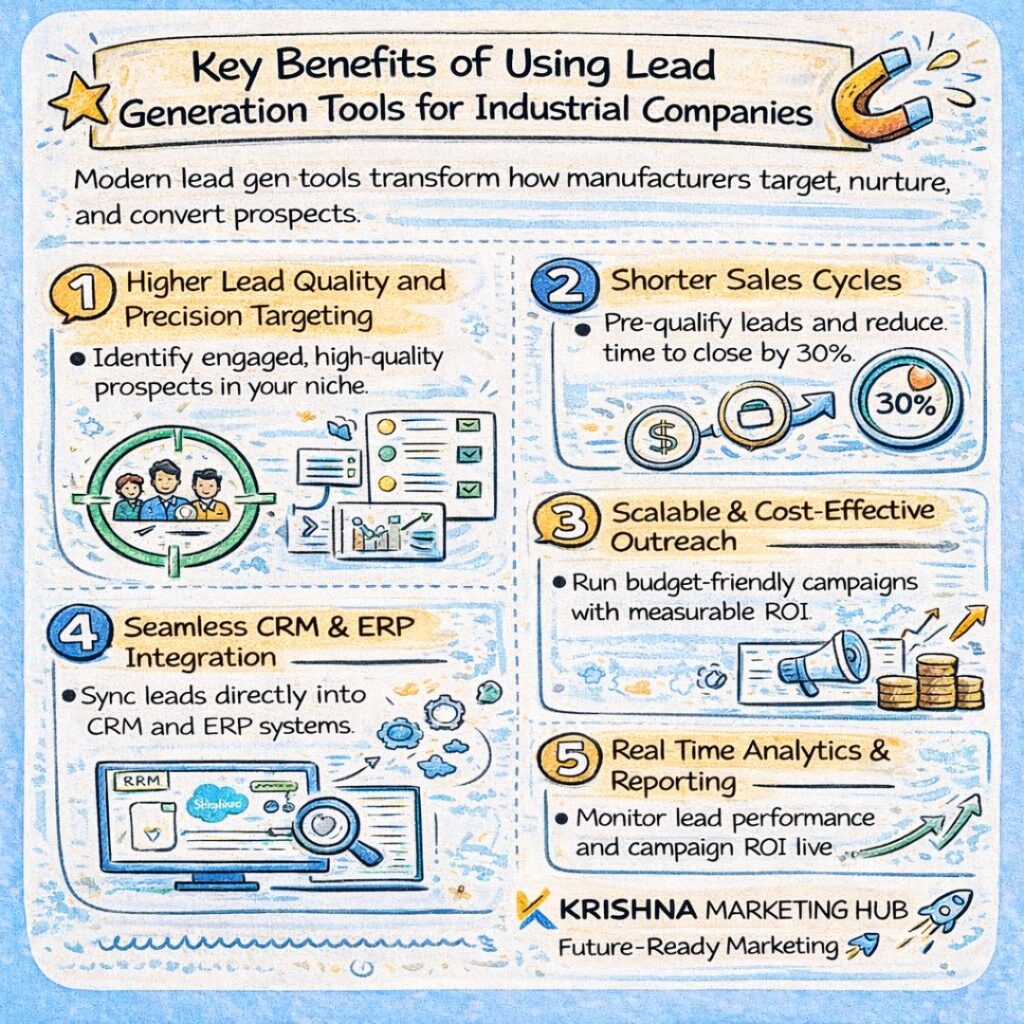
Modern lead generation tools offer industrial companies far more than a list of names and emails. Here is why KrishnaMarketingHub consistently recommends them to clients in the manufacturing and industrial space.
1. Higher Lead Quality and Precision Targeting
Advanced tools use firmographic data, intent signals, and behavioral analytics to identify prospects who are actively researching solutions in your niche. Instead of casting a wide net, you reach decision-makers — plant managers, procurement officers, and chief engineers — who are already primed to buy.
2. Shorter Sales Cycles
When leads arrive pre-qualified through automated scoring and nurturing sequences, your sales team spends less time on cold outreach and more time closing. Industrial companies using CRM-integrated lead generation tools have reported sales cycle reductions of up to 30% according to HubSpot’s 2025 State of Marketing Report.
3. Scalable and Cost-Effective Outreach
Traditional industrial marketing relied heavily on trade publications and exhibitions — expensive, infrequent, and hard to measure. Digital lead generation tools allow you to run always-on campaigns that scale with your budget, producing a measurable cost-per-lead and a trackable return on investment.
4. Seamless CRM and ERP Integration
Many leading tools integrate directly with CRM platforms like Salesforce and HubSpot, as well as ERP systems common in industrial environments. This eliminates data silos, ensures your sales and operations teams work from a single source of truth, and dramatically reduces manual data entry.
5. Real-Time Analytics and Reporting
Industrial companies can now monitor lead source performance, campaign ROI, and pipeline velocity in real time. KrishnaMarketingHub builds custom dashboards for clients so that marketing and sales leaders always know which channels are producing and which need adjustment.
Top Lead Generation Tools for Industrial Companies in 2026
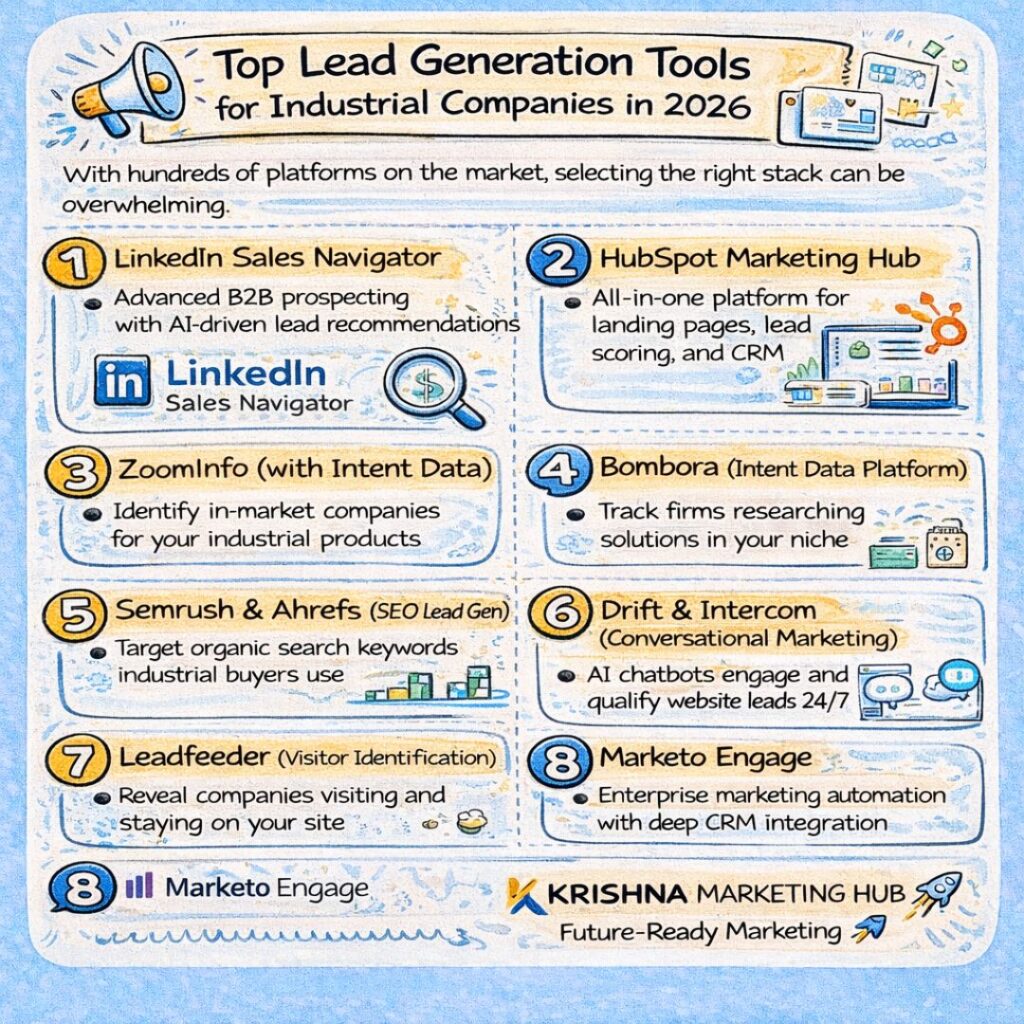
With hundreds of platforms on the market, selecting the right stack can be overwhelming. KrishnaMarketingHub has evaluated dozens of solutions and identified the following as the most impactful for industrial B2B companies in 2026.
1. LinkedIn Sales Navigator
LinkedIn remains the gold standard for B2B prospecting. Sales Navigator allows industrial companies to filter prospects by industry, company size, job title, geography, and even recent activity signals. In 2026, its AI-powered account recommendations and buyer intent features have become even more sophisticated, making it a foundational tool for any industrial sales team.
2. HubSpot Marketing Hub
HubSpot’s all-in-one platform offers landing pages, email automation, lead scoring, and CRM integration in a single ecosystem. For industrial companies producing technical content — white papers, CAD downloads, case studies — HubSpot’s gated content workflows are particularly effective at capturing high-intent leads. KrishnaMarketingHub implements and optimizes HubSpot for industrial clients across sectors including precision engineering, custom fabrication, and industrial automation.
3. ZoomInfo (with Intent Data)
ZoomInfo provides an extensive B2B database enriched with intent data, meaning you can identify companies actively researching specific industrial products or services right now. Its integration with Salesforce and HubSpot makes it easy to push qualified leads directly into your CRM pipeline. In 2026, ZoomInfo’s AI-driven account prioritization features allow industrial marketers to focus budgets on the highest-converting accounts.
4. Bombora (Intent Data Platform)
Bombora aggregates intent signals from across the web to tell you which companies are researching topics relevant to your business — before they ever visit your website. For industrial companies with long buying cycles, Bombora intent data helps sales teams reach prospects at exactly the right moment, dramatically improving conversion rates.
5. Semrush and Ahrefs (SEO Lead Generation)
Organic search remains one of the highest-quality, lowest-cost channels for industrial lead generation. Industrial buyers searching for ‘custom CNC machining services,’ ‘industrial conveyor systems,’ or ‘HVAC equipment for manufacturing plants’ represent genuinely high-intent prospects. KrishnaMarketingHub uses Semrush and Ahrefs to identify high-opportunity keywords, audit technical SEO health, and build content strategies that attract decision-makers through Google Search.
6. Drift and Intercom (Conversational Marketing)
AI-powered chatbots from Drift and Intercom engage website visitors 24/7, answer product queries, and route qualified leads to the right sales representative instantly. For industrial companies whose websites receive global traffic across multiple time zones, conversational AI tools ensure no lead falls through the cracks.
7. Leadfeeder (Website Visitor Identification)
Leadfeeder identifies the companies visiting your website even when they do not fill out a form. It integrates with Google Analytics to reveal which firms are browsing your product pages, how long they stay, and what content they engage with. This is particularly valuable for industrial companies with niche products, where even a handful of identified visitors can represent significant pipeline value.
8. Marketo Engage (Enterprise Marketing Automation)
For larger industrial enterprises with complex multi-touch buyer journeys, Marketo Engage offers enterprise-grade marketing automation including sophisticated lead scoring models, multi-channel campaign orchestration, and deep CRM integration. KrishnaMarketingHub helps industrial clients architect Marketo workflows that align with their specific sales processes and account structures.
The Role of AI Tools in Industrial Lead Generation: ChatGPT, Gemini & Beyond
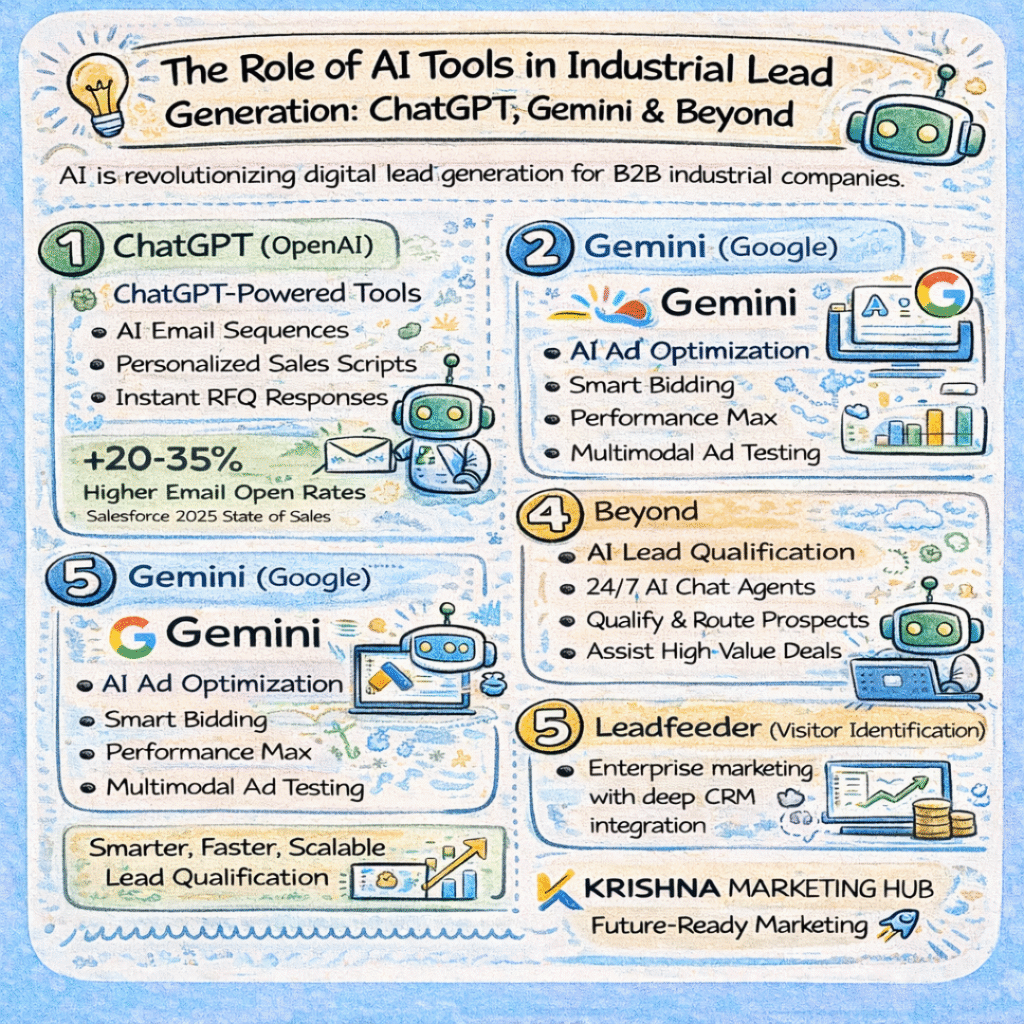
Artificial intelligence has moved from experimental to essential in B2B lead generation. In 2026, tools powered by large language models like ChatGPT (OpenAI) and Gemini (Google DeepMind) are reshaping how industrial companies create content, qualify leads, and engage prospects at scale.
ChatGPT-powered integrations are now embedded in tools like HubSpot and Drift, enabling dynamic email personalization, AI-assisted sales scripts, and instant RFQ response drafts. Industrial companies using AI-assisted email sequences have reported open rate improvements of 20-35% compared to static templates, according to Salesforce’s 2025 State of Sales report.
Gemini is particularly powerful in Google’s ecosystem — from Google Ads’ Smart Bidding to Performance Max campaigns, AI optimization is now the default. For industrial companies running search and display advertising, Gemini’s multimodal capabilities allow ad creative to be tested and optimized at speeds no human team can match.
Beyond content and advertising, AI tools are transforming lead qualification. Conversational AI agents can now conduct initial discovery calls, ask qualifying questions, and route high-priority prospects to senior sales engineers — freeing human teams to focus on complex, high-value negotiations. KrishnaMarketingHub integrates AI-assisted qualification workflows into the lead generation systems it builds for industrial clients, ensuring every inbound lead is triaged intelligently.
SEO, AEO, and GEO: Winning the SERP for Industrial Lead Generation in 2026
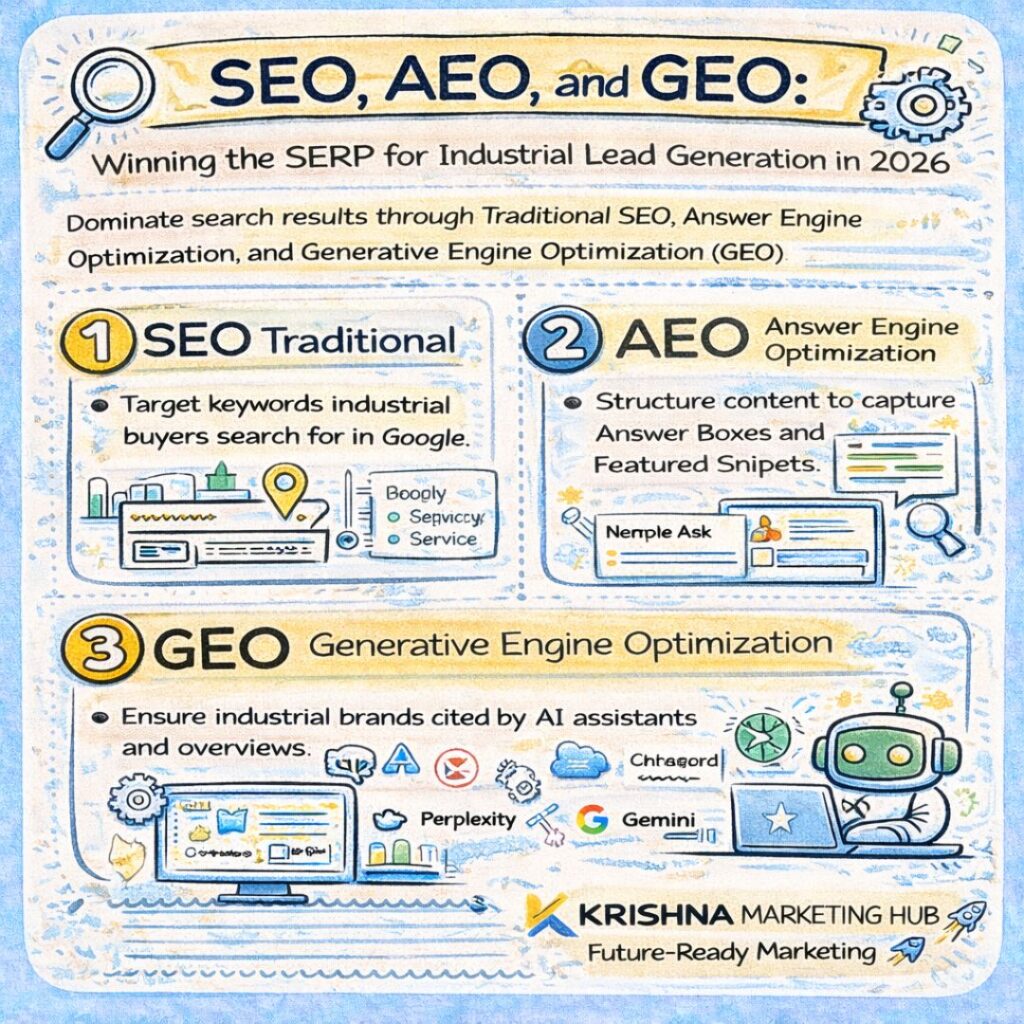
Search engine optimization remains the bedrock of long-term industrial lead generation, but the landscape in 2026 is more nuanced than ever. KrishnaMarketingHub advises industrial clients to think in three dimensions: traditional SEO, Answer Engine Optimization (AEO), and Generative Engine Optimization (GEO).
Traditional SEO focuses on ranking for high-intent keywords — product-specific, service-specific, and location-specific terms that industrial buyers type into Google. By combining technical SEO excellence, authoritative content, and high-quality backlinks from industry publications, industrial companies can generate consistent organic lead flow.
AEO addresses the growing prevalence of AI-generated answer boxes, featured snippets, and People Also Ask sections that now dominate the top of many search results pages. Structuring content with clear question-and-answer formats, schema markup, and concise factual summaries helps industrial content get featured in these prominent positions — capturing attention even before a user clicks through to your site.
GEO — Generative Engine Optimization — is the newest frontier. As users increasingly query AI assistants like ChatGPT, Perplexity, and Google’s AI Overviews for product and vendor recommendations, industrial companies must ensure their brands, products, and expertise are prominently represented in AI training data and cited sources. KrishnaMarketingHub helps industrial clients build the authoritative content ecosystems that ensure their brands appear when AI engines answer questions from industrial buyers.
Latest Trends in Industrial Lead Generation for 2026
Staying current with lead generation trends is not optional — it is a competitive necessity. Here are the developments KrishnaMarketingHub is watching most closely for industrial companies this year:
Account-Based Marketing (ABM) Goes Mainstream
ABM has crossed the chasm from enterprise-only strategy to a practical approach for mid-sized industrial companies. Tools like Terminus, 6sense, and Demandbase make it feasible to run highly personalized campaigns targeting a curated list of dream accounts, coordinating outreach across advertising, email, and direct sales touchpoints.
Video-Led Lead Generation
Short-form video — facility tours, product demonstrations, engineering explainers — is proving remarkably effective for industrial companies on LinkedIn and YouTube. Industrial buyers who engage with video content convert at significantly higher rates than those who consume text alone. KrishnaMarketingHub has helped industrial clients develop video-first content strategies that showcase technical expertise in an accessible format.
Programmatic Advertising for Industrial Niches
Programmatic ad platforms now offer industrial-specific audience segments that allow companies to serve targeted ads to procurement managers, plant engineers, and operations directors across the web. Combined with intent data from platforms like Bombora, programmatic advertising can deliver highly relevant messaging to the right decision-makers at scale.
Privacy-First Data Strategies
With third-party cookie deprecation now complete and GDPR enforcement intensifying globally, industrial companies must build first-party data strategies. This means investing in owned channels — email lists, gated content portals, customer communities — that deliver leads without reliance on diminishing third-party data sources.
WhatsApp and Messaging-Based Lead Nurturing
Across industrial markets in Asia, the Middle East, and Latin America, WhatsApp Business API has emerged as a highly effective channel for initial prospect engagement and lead nurturing. Response rates on WhatsApp significantly outperform traditional email in these geographies, making it an important channel for industrial companies with international sales ambitions.
Challenges Industrial Companies Face with Lead Generation
Despite the wealth of tools available, industrial lead generation comes with unique challenges that require careful navigation. KrishnaMarketingHub has identified the most common obstacles — and how to overcome them:
Challenge 1: Niche Audiences and Low Search Volumes
Industrial products often serve extremely specific niches. A manufacturer of custom titanium fasteners may have only a few hundred potential customers globally. Low search volumes can make SEO feel futile. The solution lies in hyper-targeted content marketing combined with ABM and direct outreach tools like LinkedIn Sales Navigator — prioritizing quality over volume.
Challenge 2: Long and Complex Sales Cycles
Industrial purchases often require multiple stakeholders, extensive technical evaluation, and lengthy procurement processes. Lead generation tools must be configured with multi-touch attribution and long-duration nurturing sequences that keep prospects engaged over months or even years without becoming intrusive.
Challenge 3: Technical Content Creation
Industrial companies possess deep technical expertise but often struggle to translate it into content that is both technically credible and accessible to digital audiences. KrishnaMarketingHub bridges this gap by working directly with engineering and sales teams to create white papers, application notes, and case studies that resonate with both technical evaluators and procurement decision-makers.
Challenge 4: Misalignment Between Sales and Marketing
A common failure mode in industrial lead generation is when marketing generates leads that sales teams dismiss as unqualified, or when sales teams ignore inbound leads because they prefer their existing relationships. Implementing shared lead scoring criteria and regular joint reviews of pipeline data is essential to ensuring alignment. The right CRM and marketing automation tools make this alignment transparent and actionable.
Challenge 5: Measuring ROI Across Long Sales Cycles
Attribution is genuinely difficult when a lead first encounters your brand at a trade show, then downloads a white paper six months later, engages with a LinkedIn ad, and finally converts 18 months after first touch. Multi-touch attribution models within platforms like HubSpot and Marketo, combined with consistent UTM tracking and CRM discipline, allow industrial marketers to build a credible picture of which activities are truly driving revenue.
Conclusion: Building Your Industrial Lead Generation Engine in 2026
The best lead generation tools for industrial companies in 2026 share a common thread: they help you find the right buyers, engage them at the right moment, and convert interest into revenue more efficiently than traditional methods ever could. From LinkedIn Sales Navigator and HubSpot to AI-powered chatbots and intent data platforms like Bombora, the modern industrial marketer has access to a genuinely powerful toolkit.
But technology alone is not the answer. The companies that win in industrial lead generation combine the right tools with a coherent strategy — one that aligns SEO, AEO, and GEO best practices, leverages AI capabilities thoughtfully, creates genuinely valuable technical content, and ensures tight alignment between sales and marketing teams.
At KrishnaMarketingHub, we have spent years helping industrial companies — from precision manufacturers to engineering service firms — build lead generation systems that deliver consistent, high-quality pipeline. We understand the unique dynamics of industrial B2B sales, and we know how to translate that understanding into digital marketing strategies that produce measurable results, including powerful Instagram marketing strategies that help industrial brands increase visibility, engage their audience, and generate qualified leads.
Frequently Asked Questions
Lead generation tools are software platforms that help businesses identify potential customers, capture their contact information, and nurture them through the sales funnel. For industrial companies — where sales cycles are long, buyers are technical, and decisions involve multiple stakeholders — these tools are critical. Modern lead generation platforms go beyond basic contact collection; they show how leads move through your funnel, which channels bring qualified prospects, and what actions lead to conversion. In industrial B2B environments, this kind of visibility dramatically reduces wasted outreach effort.
Industrial companies benefit most from tools built around B2B data intelligence and account-based marketing. Platforms like D&B Hoovers provide deep firmographic and technographic data — insights into company size, revenue, and technology stack — as well as buyer intent signals that identify companies actively researching solutions, making them ideal for niche industrial targeting. ZoomInfo, Leadfeeder, and 6sense are also widely used for their ability to surface decision-makers in specific verticals.
AI has fundamentally shifted how industrial sales teams prospect. In 2026, AI lead generation is no longer about generating more activity — it’s about signal-based selling, which prioritizes outreach based on observable intent, behavioral, and contextual signals rather than static lists or one-time data enrichment. For industrial companies with narrow target markets, this means far fewer wasted calls and a sharper focus on accounts that are actually in a buying cycle.
Intent data tracks online behavior — such as content consumption, keyword searches, and website visits — to identify companies that are actively researching solutions. Platforms like 6sense use AI to identify accounts showing buying signals across the web, analyzing anonymous website visits, content consumption, and research behavior to predict which companies are currently in-market for specific solutions. For industrial suppliers, this means reaching procurement managers at exactly the right moment.
Yes — this is one of the most powerful capabilities available to industrial marketers today. Leadfeeder uses reverse-IP lookup technology to connect anonymous website traffic to specific company profiles, providing a list of warm prospects who have already shown interest. It also tracks which pages visitors viewed and for how long, giving sales teams context-rich insight before they even pick up the phone.
CRM integration ensures that lead data flows automatically into the tools your sales team already uses, eliminating manual data entry and reducing response lag. Modern lead generation platforms pull data from multiple sources, score leads in real time, and trigger the right follow-up actions automatically — resulting in less repetitive work and more qualified conversations for sales reps.For industrial companies with long sales cycles, this continuity across the funnel is essential