
Introduction to Running Google Ads for Real Estate Listings in 2026
Google Ads for Real Estate Listings in 2026 has become one of the most powerful ways for real estate agents and property developers to generate high-quality leads online. By choosing the right targeting, keywords, and ad strategy, businesses can reach potential home buyers exactly when they are actively searching for properties. Many real estate professionals now Run Google Ads for Real Estate campaigns to promote property listings, attract serious buyers, and increase inquiries quickly. In this guide, you will learn how to run Google Ads for real estate listings effectively in 2026 and generate consistent property leads.
Running Google Ads for real estate listings means paying to appear prominently in search results when potential buyers type queries like “3 BHK apartments in Mumbai,” “luxury homes for sale near me,” or “buy flat in Ahmedabad under 60 lakhs.” Unlike organic SEO, which can take months to deliver results, Google Ads can put your listings in front of qualified buyers within hours of launching a campaign.
In 2026, the platform has evolved significantly. Google has deeply integrated machine learning and AI into its advertising ecosystem through features like Smart Bidding, Performance Max campaigns, and AI-generated ad copy suggestions. These tools give even small real estate agencies the firepower to compete with large portals and developers if configured correctly.
Why It Matters in 2026
The digital advertising landscape for real estate has undergone a dramatic transformation entering 2026. Rising property prices, increased inventory in tier-2 and tier-3 cities, and a post-pandemic surge in remote work relocation have created an extremely dynamic buyer market. Understanding why Google Ads for real estate listings matters more than ever in 2026 is critical to allocating your marketing budget wisely.
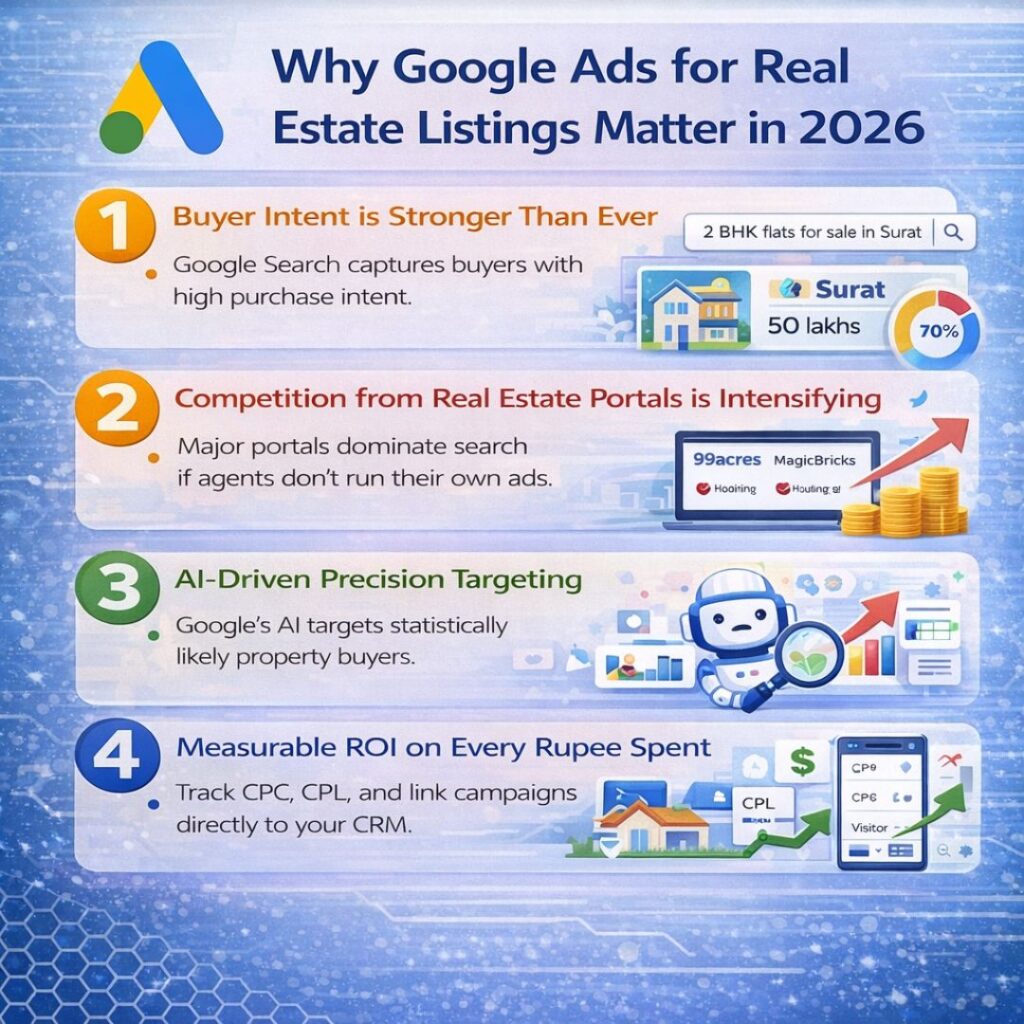
1. Buyer Intent is Stronger Than Ever
Google Search captures buyers at the highest point of purchase intent. When someone searches a specific listing like 2 BHK flat for sale in Surat under 50 lakhs, they are not casually browsing — they are actively seeking property. Unlike social media ads that interrupt users mid-scroll, Google Ads meet buyers exactly when they are ready to act. This intent-driven model makes Google Ads for real estate listings one of the highest-converting channels available.
2. Competition from Real Estate Portals is Intensifying
Portals like 99acres, MagicBricks, Housing.com, and NoBroker are spending millions on Google Ads to dominate search results. If individual agents and developers are not running their own Google Ads for real estate listings, they are essentially sending leads directly to these portals, which then charge them a listing fee to get those same leads back. Running your own campaigns gives you direct ownership of the customer relationship.
3. AI-Driven Precision Targeting
In 2026, Google’s AI has become remarkably sophisticated at predicting buyer behavior. Using signals like location history, search behavior, device usage, and even income brackets (through affinity and in-market audiences), Google can serve your real estate ads to people who are statistically most likely to convert. krishnamarketinghub uses advanced audience layering techniques to maximize this AI-driven precision for our real estate clients.
4. Measurable ROI on Every Rupee Spent
Unlike traditional advertising — hoardings, newspaper inserts, or radio spots — Google Ads gives you complete transparency on where your budget is going and what it is generating. You can track cost per click (CPC), cost per lead (CPL), cost per site visit booked, and even link ad campaigns directly to CRM data for full-funnel attribution. This makes it an indispensable tool for real estate marketing in 2026.
Key Benefits of Running Google Ads for Real Estate Listings
There are numerous advantages to using Google Ads as part of your real estate marketing mix. Below, we break down the most impactful benefits that krishnamarketinghub consistently sees among its real estate advertising clients.
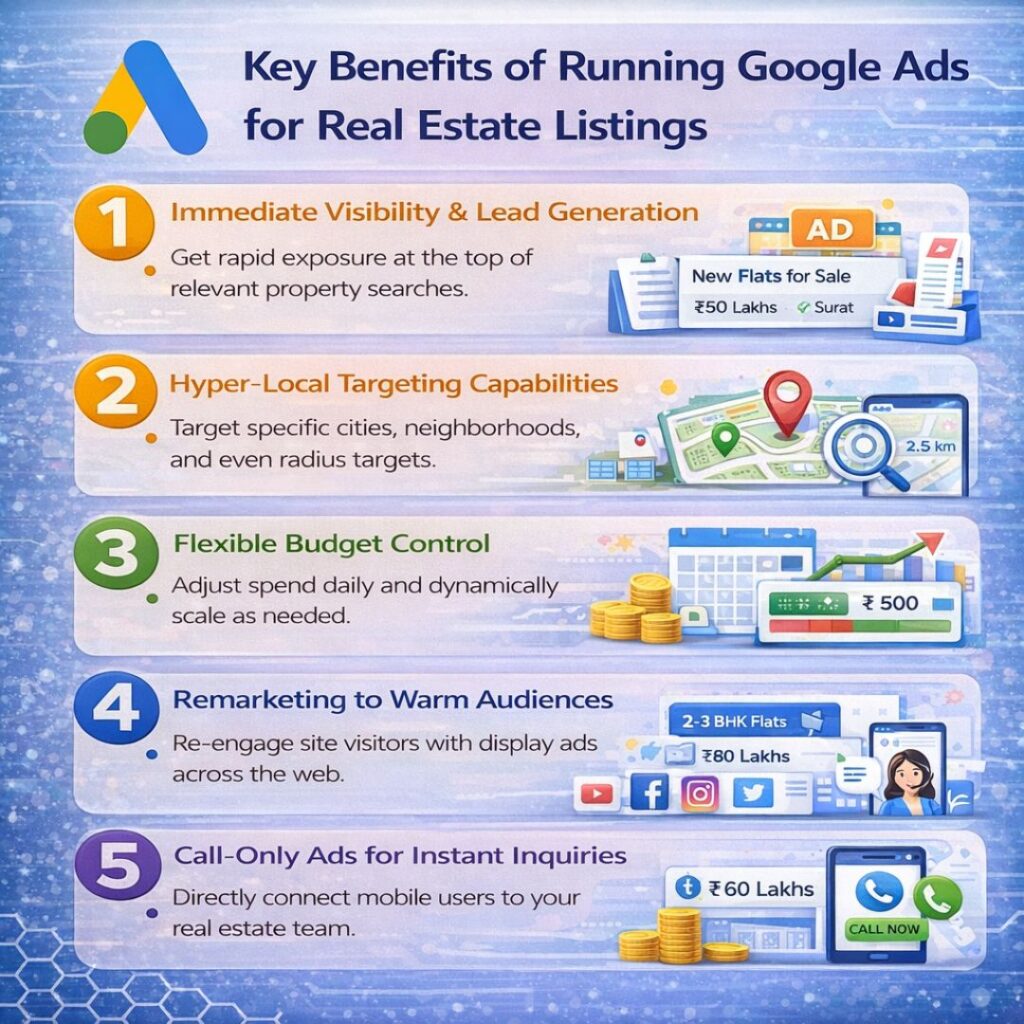
Immediate Visibility and Lead Generation
The most compelling benefit of Google Ads for real estate listings is speed. The moment your campaign goes live and your bids are competitive, your listing ads appear at the top of search results. For new project launches or time-sensitive inventory like pre-launch offers, this immediacy is invaluable. SEO may take 6–12 months to rank a real estate landing page; Google Ads can drive traffic on day one.
Hyper-Local Targeting Capabilities
Real estate is fundamentally a local business. Google Ads allows you to target by city, pin code, radius around a location, or even specific neighborhoods. In 2026, Location Extensions have become even more powerful, allowing your ads to display your project address, directions via Google Maps, and distance from the searcher. This hyper-local capability means you are never wasting budget on people who are geographically irrelevant to your listing.
Flexible Budget Control
Unlike traditional media, Google Ads allows you to start with any budget — even as low as ₹500 per day — and scale up as you see results. You can pause campaigns instantly if inventory sells out, increase spend during festive buying seasons like Diwali or financial year-end, and allocate budget dynamically across multiple projects. krishnamarketinghub helps real estate clients build dynamic budget frameworks that align ad spend with inventory status in real time.
Remarketing to Warm Audiences
One of the most powerful — and often underutilized — features of Google Ads for real estate is remarketing. When a potential buyer visits your property listing page but doesn’t inquire, you can follow them across the internet with targeted display ads showcasing that same property. Studies show that remarketing can increase conversion rates by 50–60% for real estate leads. In 2026, Google’s enhanced Customer Match feature also lets you upload your existing leads list and re-engage them through Google Ads.
Call-Only Ads for Instant Inquiries
For real estate businesses where a phone call is more valuable than a form submission, Google’s Call-Only Ads are a game-changer. These ads display only on mobile devices and feature a click-to-call button prominently. When a buyer clicks, they are connected directly to your sales team rather than to a landing page. krishnamarketinghub designs call-only ad strategies specifically for real estate teams that need to maximize direct phone inquiries.
Latest Trends and Insights: Google Ads for Real Estate in 2026
The Google Ads platform is never static. 2026 has brought a wave of updates that real estate advertisers must understand to remain competitive. krishnamarketinghub stays ahead of these trends to deliver cutting-edge campaign management for our clients.
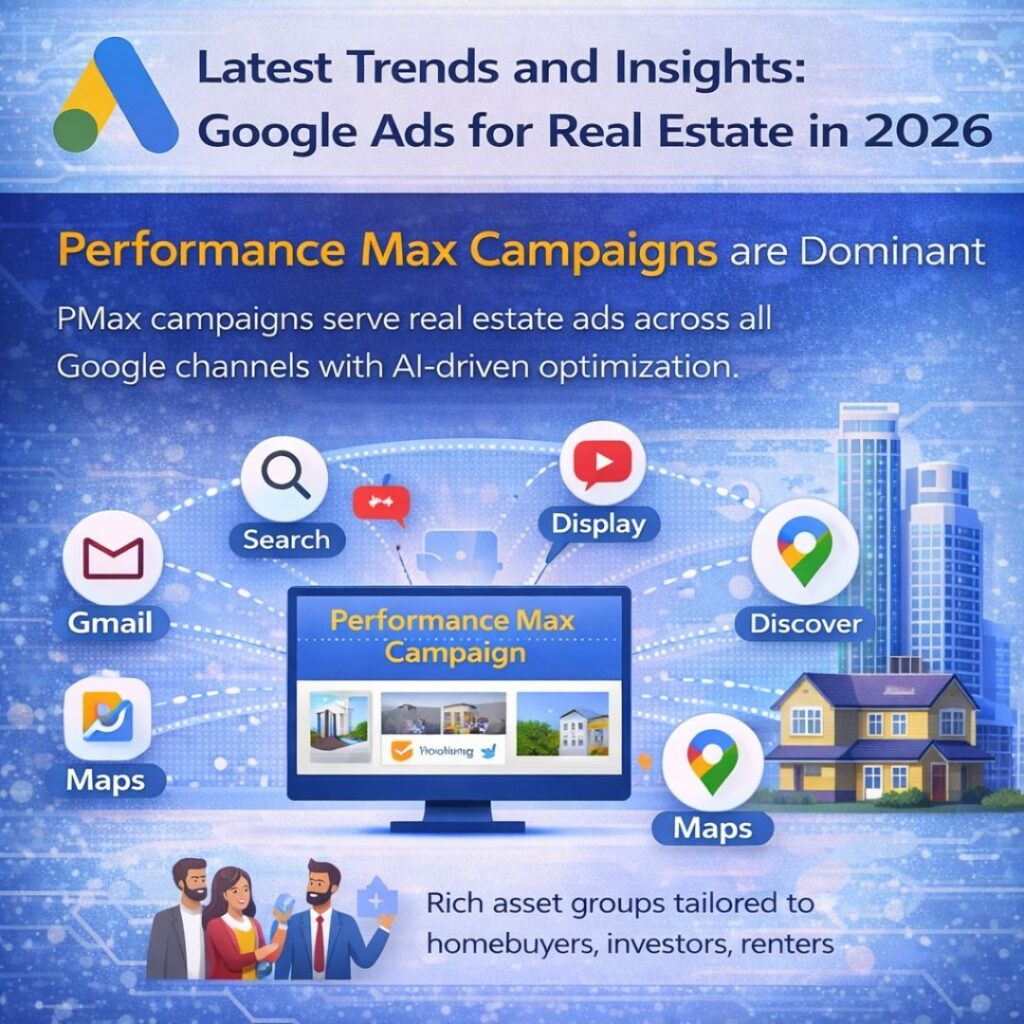
Performance Max (PMax) Campaigns are Dominant
Performance Max campaigns — which allow a single campaign to serve ads across all of Google’s channels including Search, Display, YouTube, Gmail, Discover, and Maps — have become the gold standard for real estate advertisers in 2026. By feeding Google’s AI with high-quality creative assets (images of your properties, videos of walkthroughs, compelling headlines, and detailed descriptions), PMax campaigns optimize in real time to find the best converting placements. krishnamarketinghub builds structured PMax campaigns with rich asset groups tailored to different buyer personas — first-time homebuyers, NRI investors, upgraders, and rental seekers.
AI Tools: ChatGPT, Gemini, and Ad Copy Generation
In 2026, AI tools like ChatGPT and Google’s Gemini have become integral to the ad creation workflow. Real estate marketers use ChatGPT to rapidly generate multiple variations of ad headlines and descriptions for A/B testing. Gemini, deeply embedded within the Google Ads ecosystem, now offers native suggestions for ad copy, landing page improvements, and even bidding strategy adjustments based on campaign performance data. At krishnamarketinghub, we use both tools as part of our creative workflow while always applying human expertise to ensure the copy resonates with local buyer psychology and emotional triggers specific to real estate purchases.
AEO, GEO, and SERP Rankings in 2026
The rise of Answer Engine Optimization (AEO) and Generative Engine Optimization (GEO) has reshaped how we think about Google Ads strategy. As Google Search increasingly surfaces AI-generated overviews and answer boxes at the top of the SERP, paid ads now appear in a new dynamic context. Real estate advertisers must think beyond keyword bidding and consider how their landing pages, structured data markup, and content answer specific buyer questions. krishnamarketinghub integrates AEO and GEO principles into our real estate campaign strategies — ensuring our clients’ ads and landing pages are optimized not just for traditional SERP rankings but also for visibility within Google’s AI-powered search experiences.
Voice Search and Conversational Queries
With the proliferation of smart speakers and voice-activated search on mobile, real estate buyers in 2026 are increasingly using conversational, long-tail queries like “show me 3 bedroom houses near schools in Surat under 80 lakhs.” Google Ads keyword strategies must adapt to capture these voice-driven searches. krishnamarketinghub builds comprehensive long-tail keyword libraries for real estate clients to capture voice search traffic that competitors often miss entirely.
Video Ads on YouTube for Property Showcasing
YouTube remains the world’s second-largest search engine, and for real estate — where visual presentation is everything — video ads have become essential. In 2026, YouTube’s skippable in-stream ads and YouTube Shorts ads allow real estate developers to showcase property walkthroughs, amenity tours, and project animations to targeted audiences. krishnamarketinghub produces and manages YouTube ad campaigns that integrate seamlessly with Google Ads campaigns for full-funnel retargeting.
Challenges of Running Google Ads for Real Estate Listings
While the benefits of Google Ads for real estate are substantial, the challenges are equally significant. Understanding these challenges — and how to overcome them — is what separates campaigns that drain budget from those that generate consistent, high-quality leads.
High Cost Per Click in Competitive Markets
Real estate is one of the most expensive niches on Google Ads. In major metros, CPCs for keywords like “luxury apartments Mumbai” or “buy flat Bengaluru” can range from ₹80 to ₹250 per click or more. Without proper keyword research, negative keyword lists, and Quality Score optimization, budgets can evaporate quickly with little to show for it. krishnamarketinghub addresses this through rigorous keyword qualification, precise match type selection, and continuous bid adjustment to keep CPCs within profitable ranges for each client.
Lead Quality vs. Lead Volume Trade-offs
One of the most common frustrations real estate advertisers face is generating high volumes of leads that don’t convert. Broad targeting, poorly written ads, and generic landing pages attract curious clicks rather than serious buyers. krishnamarketinghub builds qualification-focused campaigns that use ad copy, extensions, and landing page design to pre-qualify leads before they submit an inquiry, resulting in higher site visit rates and better sales team efficiency.
RERA Compliance and Ad Policy Restrictions
In India, the Real Estate Regulatory Authority (RERA) mandates specific disclosures in all real estate advertising. Google’s own ad policies also restrict certain claims in property ads. Navigating RERA compliance while maintaining compelling, conversion-focused ad copy requires both legal awareness and marketing expertise. krishnamarketinghub ensures all real estate ad campaigns meet RERA and Google policy requirements, protecting clients from ad disapprovals and regulatory risks.
Attribution Complexity in Long Sales Cycles
Real estate purchases are not impulse decisions. A buyer might see your Google ad, visit your website, leave, see a YouTube ad two weeks later, call your office, tour the property three times, and then convert months after the first click. Standard last-click attribution in Google Ads significantly undervalues the impact of upper-funnel campaigns. krishnamarketinghub implements data-driven attribution models and CRM integrations to give real estate clients a true picture of how Google Ads contributes to their sales pipeline.
Managing Multiple Project Campaigns Simultaneously
Large developers with 5, 10, or even 20 active projects face the challenge of managing multiple campaigns simultaneously — each with its own budget, keyword strategy, creative assets, and target audience. Without the right campaign architecture and automation rules, campaigns can cannibalize each other or overspend on weaker projects. krishnamarketinghub builds scalable campaign hierarchies and management frameworks that allow developers to efficiently run and monitor multi-project Google Ads portfolios.
Step-by-Step: How to Run Google Ads for Real Estate Listings in 2026
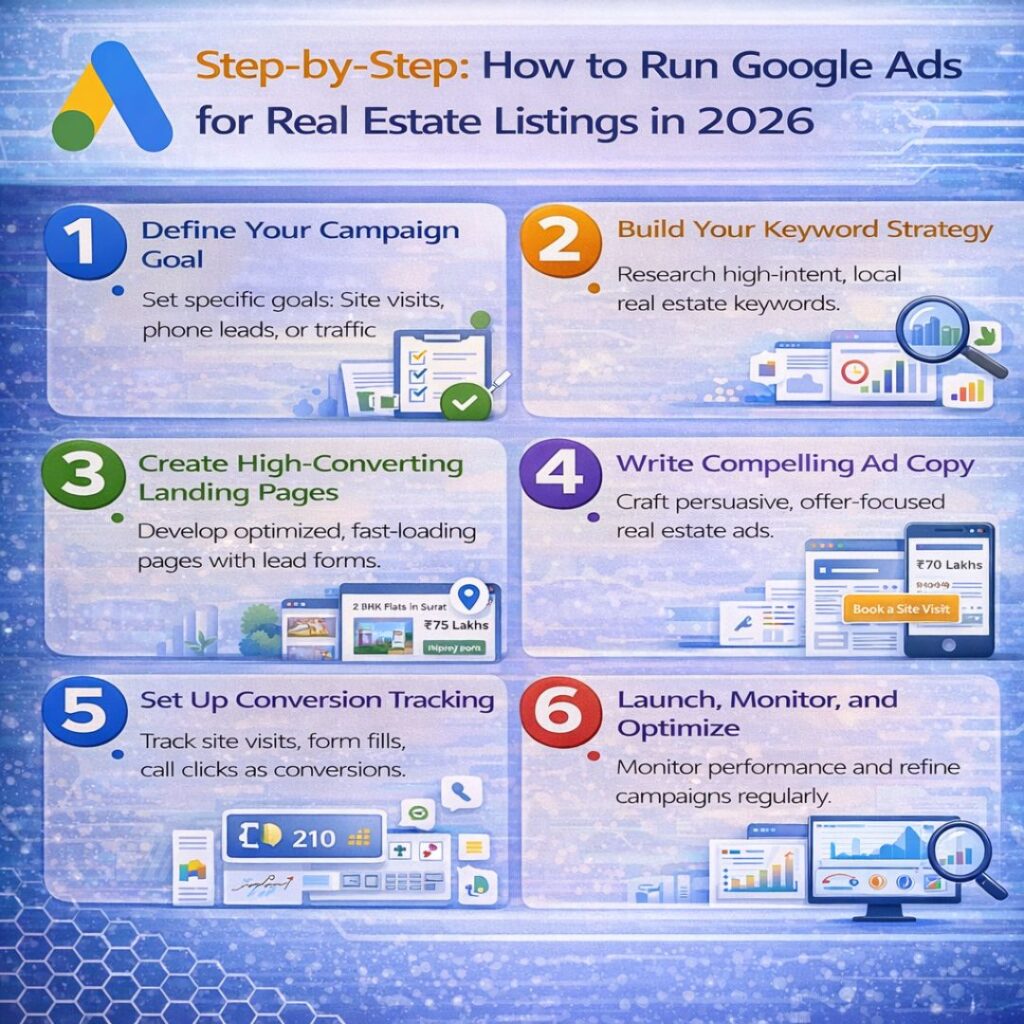
Now that you understand the landscape, benefits, trends, and challenges, here is krishnamarketinghub’s proven step-by-step process for running Google Ads for real estate listings effectively in 2026.
Step 1 – Define Your Campaign Goal
Before you spend a single rupee, define what success looks like. For real estate, this typically means one of three goals: generating site visit inquiries, collecting phone leads for immediate follow-up, or driving traffic to a project microsite or landing page. Your goal determines your campaign type (Search, PMax, or Call-Only), your bidding strategy (Target CPA, Target ROAS, or Maximize Conversions), and your conversion tracking setup.
Step 2 – Build Your Keyword Strategy
Keyword research is the foundation of any successful Google Ads campaign for real estate. Use Google Keyword Planner to identify high-intent keywords around your project location, property type, price range, and key differentiators. Include long-tail keywords that capture specific buyer intent. Equally important: build a comprehensive negative keyword list to block irrelevant searches like “rent,” “free,” “jobs,” and competitor brand names you don’t want to pay for.
Step 3 – Create High-Converting Landing Pages
Your ad is only as good as the landing page it leads to. A real estate landing page in 2026 must load in under 2 seconds on mobile, showcase professional property images and videos, include a simple inquiry form above the fold, display social proof (testimonials, sold units count), and feature a clear RERA number. krishnamarketinghub designs dedicated landing pages for each project that are built to convert rather than just inform.
Step 4 – Write Compelling Ad Copy+
Great real estate ad copy speaks directly to the buyer’s aspiration and urgency. Use your headline slots to lead with the location, property type, and a key benefit or offer. Your description should address the buyer’s fear of missing out (“Last 8 units available”), highlight a financial benefit (“EMI starts at ₹22,999/month”), and include a strong call to action (“Book a free site visit today”). Use AI tools like ChatGPT to generate multiple variations, then select and refine the best performers.
Step 5 – Set Up Conversion Tracking
Without conversion tracking, you are flying blind. Set up Google Tag Manager to track form submissions, phone call clicks, WhatsApp button clicks, and PDF brochure downloads as conversion events in Google Ads. Link your Google Ads account with Google Analytics 4 for deeper behavioral insights. If your team uses a CRM like Salesforce or Zoho, integrate it with Google Ads for closed-loop attribution that tracks which ad campaigns generated actual site visits and bookings.
Step 6 – Launch, Monitor, and Optimize
Once live, monitor your campaigns daily for the first two weeks. Watch for high-spend, low-conversion keywords and either pause them or adjust bids. Monitor your Search Terms report to identify new negative keyword opportunities. Test different ad copy variations and landing page elements. After four weeks of data collection, shift to weekly optimization reviews with monthly strategic adjustments based on overall performance trends.
Conclusion
By implementing the right strategy for Google Ads for Real Estate Listings in 2026, real estate businesses can generate consistent leads and increase property sales. Combining Google Ads with platforms like Instagram marketing for real estate can further boost visibility, helping agents showcase properties through engaging visuals and targeted social media campaigns.
The real estate professionals winning with Google Ads in 2026 are those who treat it as a strategic investment, not an experiment. They work with experienced partners who understand the unique compliance requirements, competitive dynamics, and buyer journey complexities of the real estate market. They leverage AI tools thoughtfully, integrate AEO and GEO principles into their digital presence, and build campaigns that serve buyers at every stage of their property search journey.
At krishnamarketinghub, we have helped real estate agencies, brokers, and developers across India build and scale Google Ads campaigns that consistently generate high-quality leads, fill sales pipelines, and drive project sales. Our team combines deep expertise in Google Ads, real estate marketing, RERA compliance, and data analytics to deliver campaigns that perform — not just campaigns that look good on paper.
Ready to launch Google Ads for your real estate listings in 2026? Contact krishnamarketinghub today for a free campaign audit and strategy session. Visit krishnamarketinghub.com or reach out to our team directly. Let us help you turn clicks into closings.

Frequently Asked Questions
Search campaigns remain the most effective for real estate because they capture high-intent buyers actively searching for properties. However, combining Search with Performance Max campaigns is now considered the gold standard, as it leverages Google’s AI to reach potential buyers across Search, Display, YouTube, and Gmail simultaneously.
A realistic starting budget for real estate Google Ads ranges from $1,500 to $5,000 per month, depending on your market competitiveness. High-demand metro areas may require $8,000–$15,000/month to stay competitive, while smaller markets can see solid results at lower spend. Always start with a test budget and scale based on cost-per-lead data.
Focus on high-intent, location-specific keywords such as “homes for sale in [city],” “buy a house in [neighborhood],” or “condos for sale near [landmark].” Long-tail keywords like “3-bedroom homes under $400k in [city]” tend to convert better and cost less per click than broad terms.
Effective real estate ad copy should highlight a unique value proposition — such as “No Commission Fees,” “New Listings Updated Daily,” or “Free Home Valuation.” Use numbers and specifics like price ranges, neighborhood names, and call-to-actions like “Browse Listings Now” or “Schedule a Free Tour Today” to improve click-through rates.
Always send paid traffic to a dedicated, fast-loading landing page that matches the ad’s promise. Avoid sending visitors to your homepage. A high-converting real estate landing page should include a property search tool or listing gallery, a clear lead capture form, social proof like testimonials or reviews, and a strong call-to-action.
Use radius targeting around specific neighborhoods, zip codes, or city boundaries where your listings are located. In 2026, combining location targeting with audience segments like “in-market for real estate” or custom intent audiences based on property search behavior gives you a significant edge over broad geographic targeting.