

Introduction to the Top 10 Technical SEO Checklist for 2026
Technical SEO refers to the process of optimizing the infrastructure of your website so that search engine crawlers can efficiently access, crawl, index, and render your content. Unlike on-page SEO (which focuses on content) or off-page SEO (which focuses on backlinks), technical SEO is about the nuts and bolts — the site architecture, code, server configuration, and performance elements that either open the door to search engines or slam it shut. To ensure your website meets modern search engine standards, following a Top 10 Technical SEO Checklist can help identify and fix critical technical issues that affect crawling, indexing, and overall search performance.
In 2026, technical SEO has grown significantly more complex. The proliferation of AI tools like ChatGPT and Google Gemini has transformed how users search for information, moving from keyword-based queries to natural language conversations. This shift has given birth to new optimization disciplines including AEO (Answer Engine Optimization) and GEO (Generative Engine Optimization), which require websites to be structured in ways that AI systems can easily parse, summarize, and cite.
The Top 10 Technical SEO Checklist for 2026 from Krishnamarketinghub is designed to be both practical and forward-thinking. It covers classic technical SEO fundamentals while integrating the latest developments in AI search, machine learning-based ranking, and user experience signals. Think of it as your annual website health exam — except this time, the stakes are higher than ever.
Why Technical SEO Matters in 2026
The question isn’t whether technical SEO matters — it’s whether you can afford to ignore it. In 2026, Google processes over 8.5 billion searches per day. Behind each of those searches is a sophisticated ranking system that evaluates hundreds of technical signals before deciding which page deserves to be on page one. If your website has crawl errors, poor Core Web Vitals, missing structured data, or slow load times, no amount of great content or link building will save you from poor rankings.
The rise of zero-click searches is another reason technical SEO has never been more critical. According to recent studies, nearly 65% of Google searches end without a click to an external website — largely because featured snippets, knowledge panels, and AI Overviews answer the user’s question directly on the search results page. To appear in these coveted positions, your content must be structured in a way that machines can understand, extract, and present. This is precisely where a robust technical SEO checklist becomes indispensable.
At Krishnamarketinghub, we’ve witnessed firsthand how a single technical SEO audit can transform a website’s performance. One of our e-commerce clients, for instance, saw a 143% increase in organic traffic within six months after we implemented structured data markup, fixed duplicate content issues, and optimized their Core Web Vitals scores. Technical SEO is the multiplier that makes all your other marketing efforts work harder and smarter.
Furthermore, AI-powered search engines like those powered by Google Gemini or Microsoft Copilot are increasingly evaluating websites based on their machine-readability, schema markup completeness, and content authority signals. The websites that will dominate SERP rankings in 2026 and beyond are those that align their technical infrastructure with the expectations of both traditional search algorithms and next-generation AI models.
The Top 10 Technical SEO Checklist for 2026
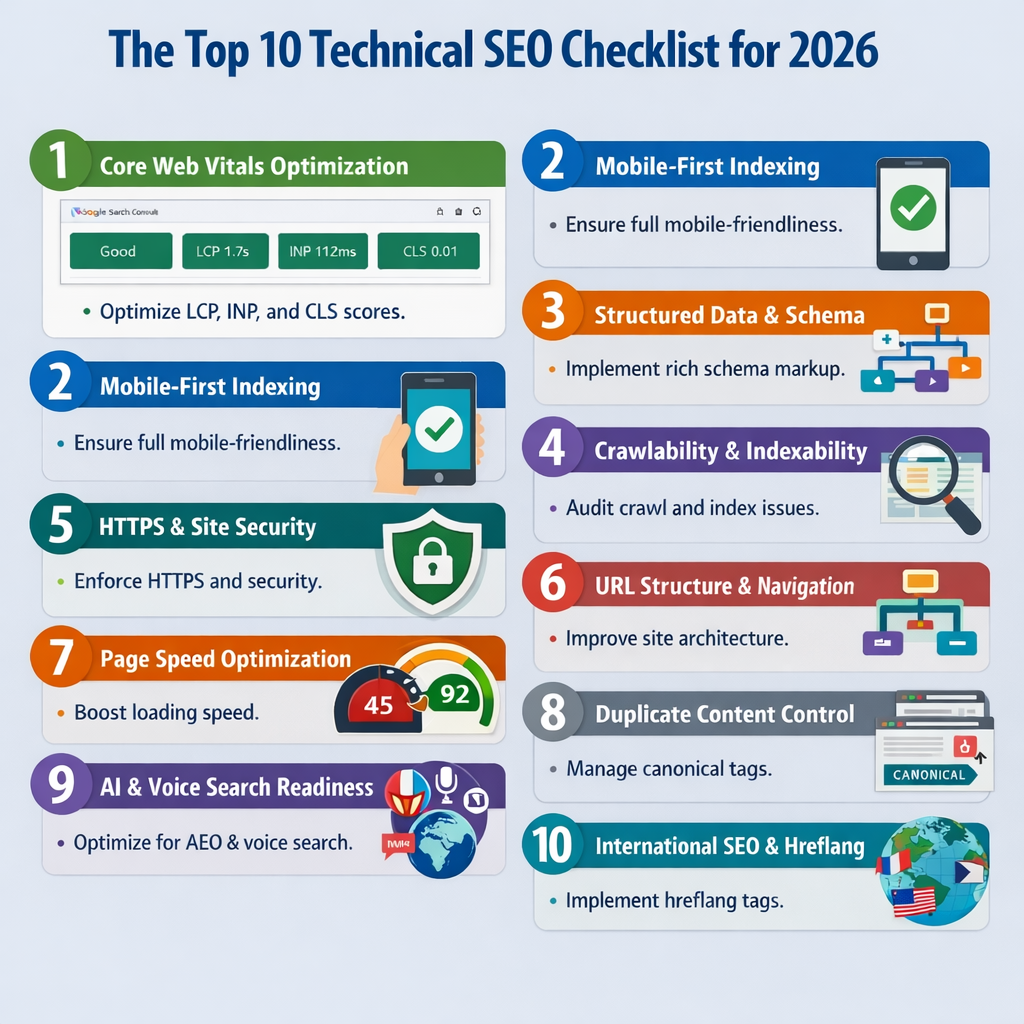
Below is the comprehensive technical SEO checklist that Krishnamarketinghub recommends for every website heading into 2026. Each item is explained in detail to give you both the what and the why.
1. Core Web Vitals Optimization
Google’s Core Web Vitals — Largest Contentful Paint (LCP), Interaction to Next Paint (INP, which replaced First Input Delay in 2024), and Cumulative Layout Shift (CLS) — remain central to the Page Experience signal in 2026. These metrics are direct indicators of how users experience your page, and Google has made it abundantly clear that poor performance will cost you rankings.
For 2026, the benchmarks are: LCP should be under 2.5 seconds, INP should be under 200 milliseconds, and CLS should be under 0.1. Achieving these benchmarks requires a multi-pronged approach including image optimization, eliminating render-blocking resources, implementing lazy loading, and leveraging browser caching. Krishnamarketinghub offers dedicated Core Web Vitals audits that identify exactly which elements are dragging down your scores and provide actionable remediation plans.
2. Mobile-First Indexing Compliance
Google has been fully mobile-first since 2021, meaning it primarily uses the mobile version of your content for indexing and ranking. In 2026, this is no longer a trend — it’s a baseline requirement. Yet surprisingly, many websites still fail to meet mobile-first standards due to issues like content hidden behind tabs on mobile, unplayable media, different structured data between mobile and desktop, or slower mobile performance relative to desktop.
Your technical SEO checklist for 2026 must include a thorough mobile audit. Use Google’s Mobile-Friendly Test tool and verify in Google Search Console that your mobile and desktop versions serve the same primary content, meta tags, and structured data. Additionally, ensure that your responsive design actually works across a variety of screen sizes — not just iPhones and standard Android devices. Tablets, foldable phones, and even smart TVs are all increasingly part of the browsing landscape.
3. Structured Data and Schema Markup
Structured data has gone from being an ‘SEO extra’ to an essential pillar of both traditional and AI-driven search optimization. In 2026, schema markup directly influences whether your content appears in rich results, knowledge panels, AI Overviews, and the growing number of AEO-driven answer boxes. Schema types like Article, FAQ, Product, Review, LocalBusiness, HowTo, BreadcrumbList, and VideoObject are the most impactful for SERP visibility.
For GEO (Generative Engine Optimization) purposes, structured data helps AI models like Google Gemini and ChatGPT understand the context, authority, and factual basis of your content. Websites with complete, validated schema markup are significantly more likely to be cited in AI-generated answers. Krishnamarketinghub’s structured data implementation services cover the full schema ecosystem — from basic Article markup to complex e-commerce product schemas with nested reviews, pricing, and availability data.
4. Crawlability and Indexability Audit
If search engines can’t crawl and index your pages, nothing else in your technical SEO checklist matters. In 2026, with websites growing larger and more complex, crawl budget management has become a critical discipline. Your robots.txt file, XML sitemaps, canonical tags, noindex directives, and internal linking structure all play a role in guiding search engine crawlers to the pages that matter most.
A common mistake that Krishnamarketinghub encounters during audits is websites inadvertently blocking important pages via robots.txt misconfigurations, or having thousands of thin, duplicate, or low-value pages indexed that dilute crawl budget. For 2026, your crawlability checklist should include regular crawl simulations using tools like Screaming Frog or Sitebulb, verification that your sitemap is up-to-date and submitted in Google Search Console, and a systematic approach to managing orphan pages, redirect chains, and 404 errors.
5. HTTPS Security and Site Safety
HTTPS has been a Google ranking factor since 2014, but in 2026 the expectations around website security have become considerably more sophisticated. Simply having an SSL certificate is no longer enough. Google and modern browsers now evaluate HSTS (HTTP Strict Transport Security) headers, mixed content warnings, certificate chain validity, and the overall security posture of your server configuration.
Beyond encryption, your 2026 technical SEO checklist should address content security policies (CSP headers), regular malware scanning, and ensuring that your site isn’t serving any third-party scripts that could compromise user data or trigger browser security warnings. A site flagged for security issues can see ranking drops of 50% or more overnight — a scenario Krishnamarketinghub has helped numerous clients recover from through comprehensive security and SEO remediation.
6. URL Structure and Site Architecture
A logical, clean URL structure and well-organized site architecture are foundational to both user experience and search engine crawling efficiency. In 2026, with AI-powered search engines parsing the semantic context of entire websites (not just individual pages), the hierarchical structure of your content matters more than ever. Google’s systems are adept at understanding topical authority, and a well-structured site tells a clear story about what your website is about and which pages are the most authoritative.
Best practices for 2026 include keeping URLs short, descriptive, and keyword-rich; using hyphens instead of underscores; avoiding dynamic parameters where possible; ensuring no page is more than three clicks from the homepage; and implementing a flat architecture that maximizes internal link equity distribution. Krishnamarketinghub’s SEO architects specialize in redesigning site structures that dramatically improve crawl efficiency and ranking performance.
7. Page Speed and Technical Performance
Page speed has been a ranking factor for years, but in 2026 it intersects with user experience signals, AI-readability, and conversion optimization in ways that make it arguably the most impactful technical variable on your checklist. Slow websites don’t just rank lower — they convert worse, generate higher bounce rates, and receive lower crawl frequency from Google’s bots.
The 2026 technical SEO checklist for page speed should cover: implementing a CDN (Content Delivery Network), enabling Gzip or Brotli compression, minifying CSS, JavaScript, and HTML, optimizing and serving next-gen image formats like WebP and AVIF, leveraging HTTP/3 where available, reducing third-party script payload, and implementing critical CSS rendering. Krishnamarketinghub’s performance optimization team has consistently achieved 40-70% improvements in page speed scores for clients across industries.
8. Duplicate Content and Canonicalization Management
Duplicate content remains one of the most pervasive and damaging technical SEO issues in 2026, particularly for e-commerce sites with faceted navigation, news sites with syndicated content, and any site that has grown organically without a strong content governance policy. When search engines encounter multiple pages with identical or very similar content, they face a difficult choice: which page should rank? Often, the wrong page wins — or worse, none of them rank at all.
The technical SEO checklist items for duplicate content include: properly implemented canonical tags (rel=canonical) pointing to the preferred version of each URL; hreflang attributes for multi-language or multi-region sites; 301 redirects for deprecated URLs; consistent use of trailing slashes; and parameter handling rules configured in Google Search Console. Krishnamarketinghub has resolved complex canonicalization issues for clients that have resulted in immediate ranking recoveries for their most valuable pages.
9. AI Optimization: AEO, GEO, and Voice Search Readiness
This is arguably the most transformative item on the 2026 technical SEO checklist. The emergence of AI-powered answer engines — including ChatGPT’s web-browsing capabilities, Google’s AI Overviews powered by Gemini, and Microsoft Copilot’s Bing integration — has fundamentally changed the search landscape. AEO (Answer Engine Optimization) focuses on structuring content so that AI systems can extract clear, authoritative answers to user queries. GEO (Generative Engine Optimization) takes this further by optimizing for how large language models cite and recommend sources.
For AEO, your content should directly answer questions in the first paragraph, use FAQ schema markup, and include clear definitions, numbered steps, and concise summaries. For GEO, you need to build topical authority through comprehensive content clusters, earn high-authority backlinks, and ensure your brand is mentioned and cited consistently across the web. Voice search readiness — another dimension of AI optimization — requires conversational keyword targeting and ensuring your pages answer common spoken queries.
At Krishnamarketinghub, we’ve developed a proprietary AEO/GEO optimization framework that helps our clients appear in AI-generated answers across multiple platforms. As AI tools like ChatGPT and Google Gemini become the default interface for information retrieval, being cited in their outputs is the new form of organic traffic. This is not future-proofing — it’s current-proofing your SEO strategy for 2026 and beyond.
10. International SEO and Hreflang Implementation
For businesses operating across multiple countries or languages, international SEO is a technically complex area that sits squarely on this 2026 checklist. Incorrectly implemented hreflang attributes, duplicate content across regional versions, and poor geotargeting configurations are common culprits behind international websites failing to capture their full global search potential.
The 2026 best practices for international technical SEO include using country-specific top-level domains (ccTLDs), subdirectories, or subdomains with clear geotargeting; implementing hreflang annotations for every language/region variant; ensuring that alternate pages return 200 status codes; and using country-specific hosting or CDN configurations for maximum performance in target markets. Krishnamarketinghub has deep expertise in international SEO, having successfully expanded clients’ organic reach into Europe, Southeast Asia, and the Middle East markets.
Key Benefits of Following the Technical SEO Checklist for 2026
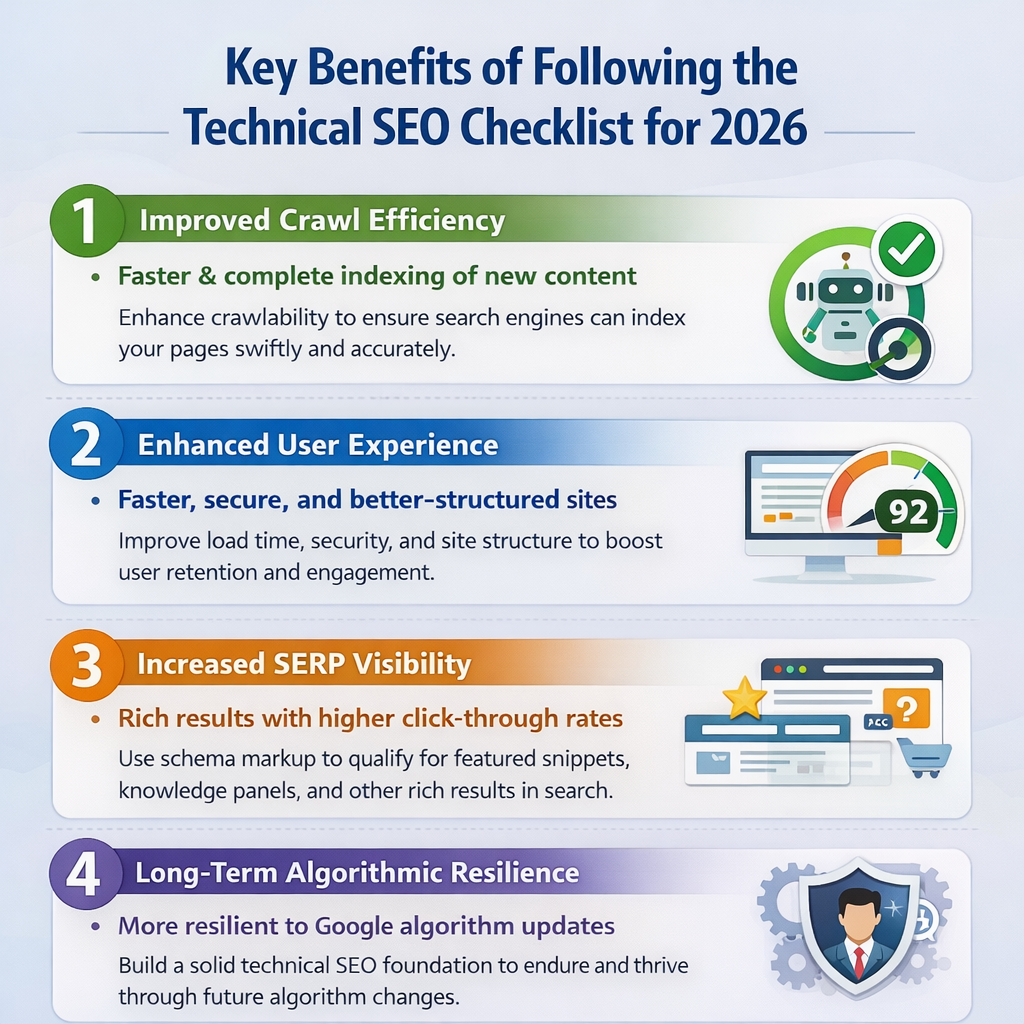
Implementing the technical SEO checklist for 2026 delivers a cascade of measurable benefits that extend far beyond search rankings. When Krishnamarketinghub conducts technical SEO implementations for clients, we track these benefits through a comprehensive KPI dashboard that ties technical improvements directly to business outcomes.
The most immediate benefit is improved crawl efficiency. When search engines can navigate your site without encountering errors, redirects, or blocked resources, they index your pages faster and more completely. This translates directly into faster ranking of new content — a competitive advantage in fast-moving industries. One Krishnamarketinghub client in the fintech space saw new product pages indexed within 24 hours of publication (down from 2-3 weeks) after our crawlability overhaul.
Enhanced user experience is another profound benefit. Technical SEO and UX are deeply intertwined — a fast, well-structured, secure website doesn’t just rank better, it also retains visitors longer, drives higher engagement rates, and converts at a significantly higher rate. Studies consistently show that a one-second improvement in page load time can increase conversions by up to 7%. When you follow a rigorous technical SEO checklist, you’re simultaneously optimizing for users and search engines.
Increased SERP visibility through rich results is a benefit that has grown dramatically in importance. Sites with complete schema markup are eligible for featured snippets, knowledge panels, FAQ boxes, how-to cards, product carousels, and — increasingly — AI Overview citations. These rich results capture significantly more click-through traffic than standard blue links, giving technically optimized sites a substantial competitive advantage.
Long-term algorithmic resilience is perhaps the most strategic benefit. Websites built on a solid technical SEO foundation are less vulnerable to algorithm updates. When Google rolls out a core update, it’s typically the sites with strong technical fundamentals, high-quality content, and authoritative backlinks that weather the storm — and often gain ground. Krishnamarketinghub’s approach is to build sites that aren’t just optimized for today’s algorithms but designed to perform through the inevitable changes ahead.
Latest Trends and Insights in Technical SEO for 2026
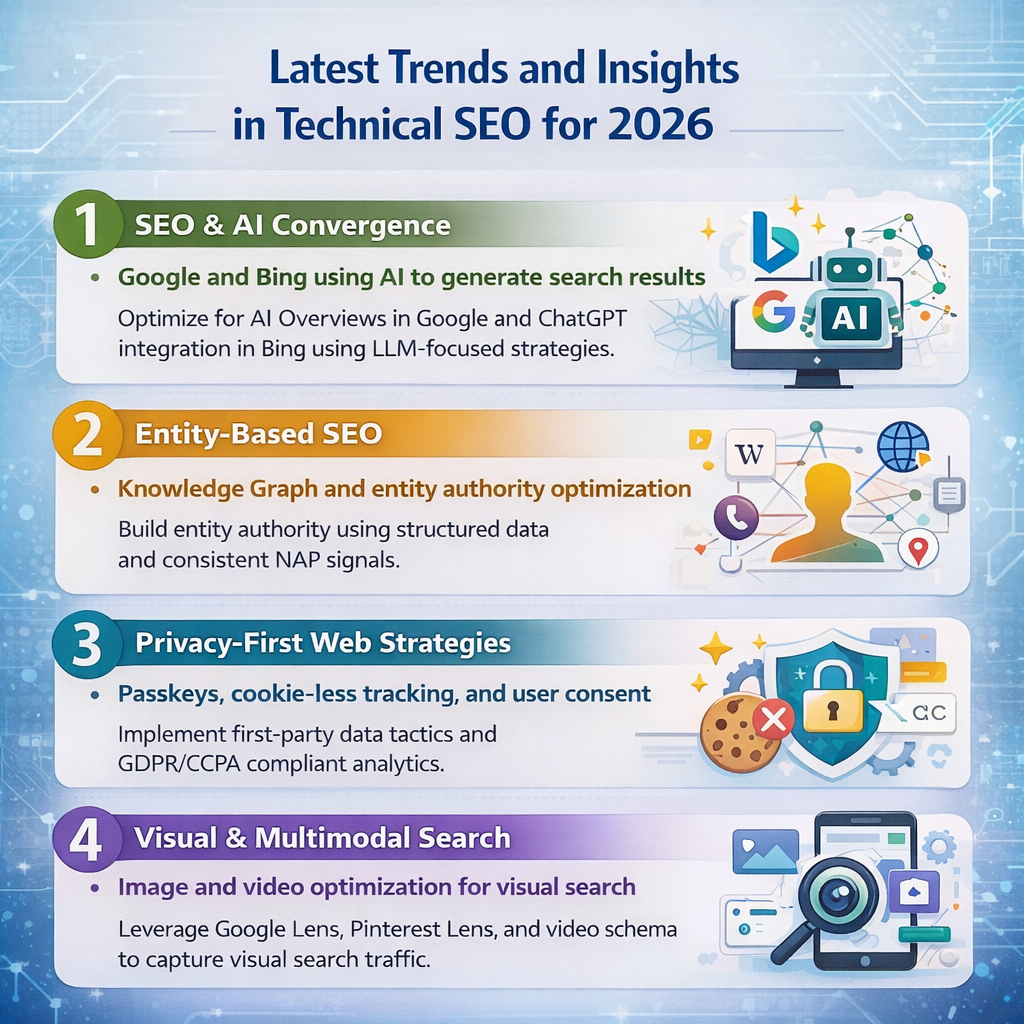
The technical SEO landscape in 2026 is being shaped by several powerful trends that every digital marketer and webmaster needs to understand. Krishnamarketinghub stays at the forefront of these developments to ensure our clients are always ahead of the curve.
The most significant trend is the convergence of SEO and AI. Google’s Search Generative Experience has evolved into a mature AI Overview product that now appears for a substantial percentage of queries. Bing’s integration with ChatGPT has similarly transformed the Microsoft search ecosystem. For technical SEO professionals, this means that optimization strategies must now account for how LLMs (Large Language Models) parse and evaluate web content — a discipline that requires a blend of traditional SEO expertise and emerging AI literacy.
Entity-based SEO has emerged as a dominant paradigm. Google’s Knowledge Graph evaluates websites not just as collections of keywords but as entities with attributes, relationships, and authority signals. Building entity authority — through consistent NAP (Name, Address, Phone) data, Wikipedia presence, knowledge panel ownership, structured data, and authoritative mentions — has become a critical component of the technical SEO checklist for 2026.
Passkeys and privacy-first web technologies are also influencing technical SEO. As third-party cookies are phased out and privacy regulations like GDPR and CCPA become more stringent, websites that handle user data responsibly — with proper consent management, first-party data strategies, and privacy-compliant analytics — are earning trust signals that increasingly factor into search rankings.
Finally, the rise of visual and multimodal search — powered by Google Lens, Pinterest Lens, and AI-enhanced image search — is creating new technical SEO opportunities around image optimization, video schema, and visual content indexing. Krishnamarketinghub has been at the forefront of helping clients optimize their visual assets for this rapidly growing search modality.
Challenges in Technical SEO for 2026
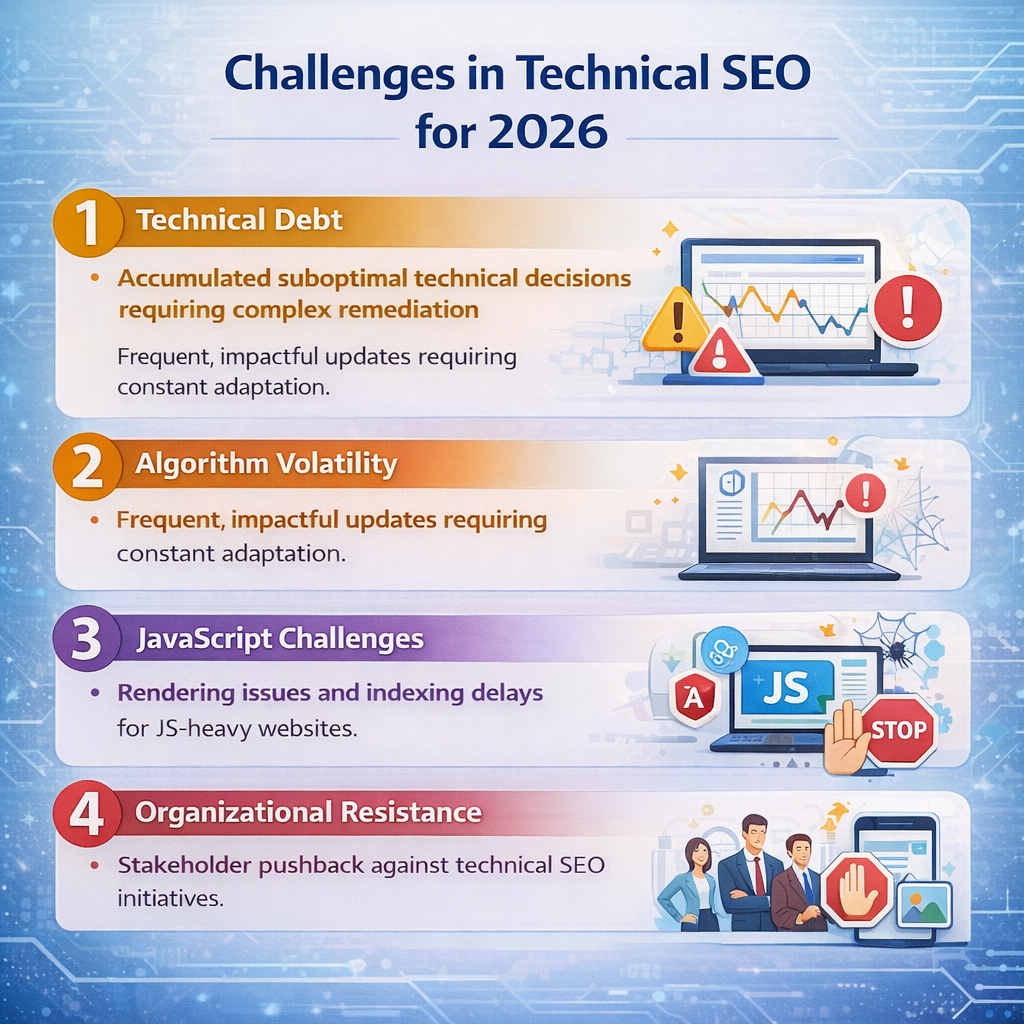
Despite the clear roadmap provided by a technical SEO checklist, implementation is rarely straightforward. The challenges that Krishnamarketinghub encounters most frequently fall into several key categories, each requiring expertise, resources, and strategic planning to overcome.
Technical debt is perhaps the most common challenge. Many established websites have accumulated years of suboptimal technical decisions — broken redirects, deprecated plugins, inconsistent URL structures, and bloated codebases — that create complex dependencies. Fixing one issue can unintentionally create another, which is why technical SEO remediation requires a systematic, phased approach rather than quick fixes. Krishnamarketinghub’s audit methodology always begins with a complete technical debt inventory before prioritizing interventions.
The rapidly evolving algorithm environment creates another significant challenge. Google updates its search algorithm thousands of times per year, and major core updates can significantly shift ranking landscapes within days. Keeping up with these changes — while simultaneously managing client expectations and business objectives — requires constant learning, testing, and adaptation. Krishnamarketinghub invests heavily in staying current with algorithm developments through direct engagement with Google’s official communications, industry research, and our own testing environments.
JavaScript-heavy websites present a persistent technical SEO challenge. Single-page applications (SPAs) built with React, Angular, or Vue.js can be difficult for search engine crawlers to render, particularly for content that is loaded dynamically. In 2026, while Google has improved its JavaScript rendering capabilities, there are still significant delays between crawling and rendering that can negatively impact indexing speed. Server-side rendering (SSR) or static site generation (SSG) are often the recommended solutions, but implementing them on existing sites can be complex and resource-intensive.
Organizational resistance is a non-technical but equally significant challenge. Technical SEO recommendations often require changes to website code, server configurations, and content management systems — changes that involve developers, IT teams, and sometimes C-suite approval. At Krishnamarketinghub, we’ve learned that SEO success requires as much stakeholder management as technical expertise. Our consultants are trained to communicate technical SEO value in business terms, making it easier for organizations to prioritize and implement our recommendations.
The challenge of maintaining technical SEO quality at scale is particularly acute for large websites. E-commerce sites with millions of product pages, news publishers with decades of archived content, or global enterprises with hundreds of regional websites face unique scalability challenges that require automated monitoring, programmatic SEO strategies, and sophisticated governance frameworks.
Conclusion: Building Your Technical SEO Foundation for 2026 and Beyond
The Top 10 Technical SEO Checklist for 2026 is not just a to-do list — it’s a strategic framework for sustainable organic growth in an increasingly complex, AI-driven digital environment. From Core Web Vitals and structured data to AEO, GEO, and AI optimization, each item on this checklist addresses a critical dimension of how search engines — and AI models — evaluate, rank, and cite your content.
Throughout this guide, we’ve established that technical SEO in 2026 requires a holistic approach. You need to optimize for speed and performance (Core Web Vitals, page speed), ensure search engines can find and understand your content (crawlability, structured data, site architecture), protect your users and your brand (HTTPS, security), and position yourself for the AI-driven future (AEO, GEO, voice search readiness). No single element works in isolation — the magic happens when all ten components of this technical SEO checklist work in concert.
The websites that will lead their industries in search visibility in 2026 are being built — or rebuilt — right now. The question is: is your website among them? If you’re unsure where your site stands, or if you know it has technical issues that have been holding back your rankings, this is the moment to act.
Ready to Transform Your Technical SEO?
Krishna Marketing Hub is your trusted partner for comprehensive technical SEO audits, implementation, and ongoing optimization. Our team of experienced SEO professionals, developers, and content strategists work together to implement every item on the technical SEO checklist for 2026 — tailored to your specific industry, website size, and business goals. In addition to technical SEO, we also help businesses grow through strategic Instagram marketing, ensuring your brand gains visibility, engagement, and high-quality leads from social platforms like Instagram.
- Schedule a free technical SEO audit with Krishnamarketinghub and discover exactly what’s holding your website back.
- Subscribe to the Krishnamarketinghub newsletter for weekly technical SEO insights, algorithm update analyses, and actionable tips.
- Explore Krishnamarketinghub’s full range of SEO services, from technical audits and on-page optimization to content strategy and AI-powered search optimization.
- Contact the Krishnamarketinghub team directly at [your contact page URL] — we respond within 24 hours.
Don’t wait for your competitors to outrank you. In 2026’s competitive digital landscape, technical SEO is not a luxury — it’s a necessity. Let Krishnamarketinghub help you build the technical foundation that turns your website into a search engine magnet.

Frequently Asked Questions
Technical SEO refers to optimizing a website’s infrastructure so that search engines can efficiently crawl, index, and rank its pages. In 2026, it matters more than ever because Google’s algorithms now heavily reward Core Web Vitals performance, mobile-first indexing, and structured data accuracy. Without a solid technical foundation, even the best content may struggle to rank competitively.
The three key Core Web Vitals remain Largest Contentful Paint (LCP), Interaction to Next Paint (INP) — which replaced First Input Delay in 2024 — and Cumulative Layout Shift (CLS). Google now uses these as direct ranking signals. Aim for LCP under 2.5 seconds, INP below 200ms, and CLS under 0.1 for optimal performance and ranking eligibility.
Mobile-first indexing is no longer optional — it is the default standard for all websites. Google primarily uses the mobile version of your site for indexing and ranking. Ensure your mobile site has the same content, metadata, structured data, and canonical tags as the desktop version. Sites with poor mobile performance risk significant ranking drops.
Crawl budget determines how many pages Googlebot will crawl on your site within a given timeframe. For large sites, poor crawl budget management means important pages may go unindexed. To optimize it: block low-value pages via robots.txt, eliminate redirect chains, fix broken internal links, and submit clean XML sitemaps. Prioritize your most valuable and frequently updated pages.
HTTPS has been a confirmed Google ranking signal since 2014, and in 2026 it remains a baseline requirement. Beyond rankings, Google Chrome labels non-HTTPS sites as ‘Not Secure,’ which increases bounce rates and destroys user trust. Additionally, ensure your SSL certificate is valid, properly configured, and that all HTTP pages permanently redirect (301) to their HTTPS equivalents.
Page speed directly influences both Core Web Vitals scores and user experience metrics, both of which affect rankings. Effective speed optimization techniques include implementing lazy loading for images and videos, minimizing render-blocking JavaScript and CSS, leveraging browser caching, using a Content Delivery Network (CDN), and serving next-gen image formats such as WebP or AVIF.